Introduction
In the gold mining industry, Carbon in Pulp (CIP) is one of the most widely used gold recovery processes. While crushing, grinding, leaching, and adsorption all play important roles, activated carbon is the true heart of the CIP circuit.
The quality, structure, and management of activated carbon directly determine:
Gold adsorption efficiency
Overall recovery rate
Operating stability
Long-term operating cost
This article provides a clear, practical, and engineering-oriented overview of the core requirements for activated carbon used in gold CIP plants.
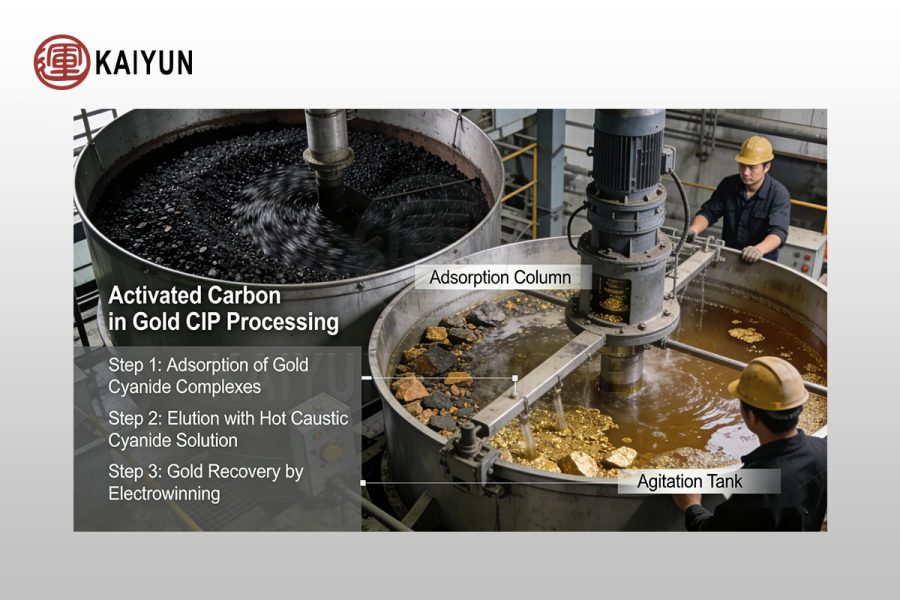
What Role Does Activated Carbon Play in CIP?
In the CIP process, gold is dissolved into solution as the [Au(CN)₂]⁻ complex during cyanide leaching. Activated carbon is then added to the pulp, where it selectively adsorbs dissolved gold from the slurry.
The loaded carbon is subsequently stripped, regenerated, and reused in a continuous cycle.
Poor-quality carbon = low gold recovery, high losses, and unstable operation.
Core Technical Requirements for CIP Activated Carbon
1. High Gold Adsorption Capacity
Activated carbon must be able to adsorb large amounts of gold efficiently.
Typical requirements:
Gold loading capacity: 10–25 kg Au per ton of carbon
Fast adsorption kinetics
Why it matters:
Higher loading reduces carbon inventory
Lower stripping and regeneration costs
Improved plant throughput
2. Optimized Pore Structure (Micropore-Dominant)
Gold cyanide complexes are extremely small, so pore structure is critical.
Key parameters:
Dominant micropores (<2 nm)
Specific surface area: 900–1200 m²/g
Engineering insight:
Even carbon with high surface area may perform poorly if pore size distribution is unsuitable.
3. High Mechanical Strength and Low Attrition
CIP tanks operate under continuous agitation, causing severe mechanical stress on carbon particles.
Typical standards:
Abrasion number: ≥95%
Low breakage and fines generation
Why strength matters:
Carbon fines carry gold out of the circuit
Excess fines block interstage screens
Carbon loss increases operating cost
4. Proper Particle Size Distribution
Carbon particle size must balance adsorption efficiency and physical retention.
Common specifications:
6×12 mesh (1.7–3.35 mm)
8×16 mesh (1.18–2.36 mm)
Selection logic:
Too small → high loss and wear
Too large → slow adsorption kinetics
5. Low Ash and Impurity Content
Ash and inorganic impurities reduce effective adsorption sites.
Recommended limits:
Ash content: ≤5%
Low calcium, magnesium, iron contamination
Operational impact:
High ash increases acid washing demand
Reduces effective carbon life
6. Good Regeneration Performance
Activated carbon must withstand repeated thermal regeneration cycles.
Performance expectation:
Stable adsorption capacity after regeneration
Maintained mechanical strength
High-quality carbon can typically remain in service for 3–5 years or longer.
7. Chemical Stability in CIP Conditions
CIP environments are chemically aggressive.
Carbon must remain stable under:
pH 10–11
High cyanide concentration
Presence of lime and oxidizing agents
It should not:
Dissolve
Release contaminants
React with process chemicals
Conclusion
In gold CIP processing, activated carbon is not a consumable detail—it is a strategic process component.
Choosing the right activated carbon ensures:
Higher gold recovery
Stable operation
Lower operating cost
Long carbon service life
Understanding and controlling carbon quality is essential for profitable gold production.