In the cyanide leaching process of gold ore, the choice of adsorbent directly affects the gold recovery rate and production costs.
Common adsorbents fall into two main categories: activated carbon and resin.
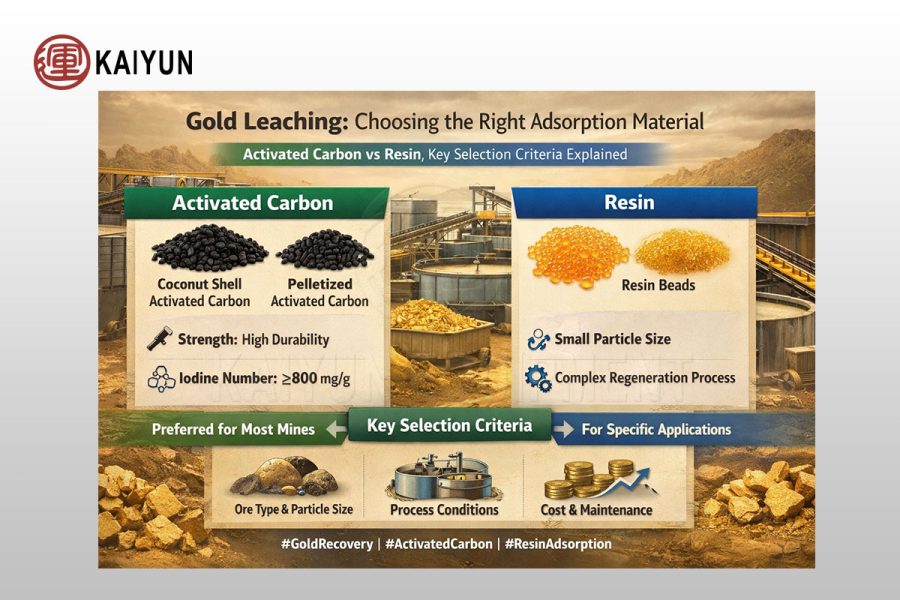
Activated Carbon: The Mainstream Choice, More Stable and Reliable
In actual production, most mines prioritize coconut shell activated carbon or columnar activated carbon. To judge the quality of activated carbon, focus on two key indicators:
Strength: Determines its resistance to breakage. During stirring, low-strength activated carbon is prone to breakage, leading to increased gold loss.
Iodine Value (Adsorption Capacity): Reflects adsorption capacity; generally, a value ≥800 mg/g is required. The higher the value, the stronger the gold adsorption capacity.
Coconut shell activated carbon: High strength and good wear resistance, the mainstream choice in the gold mining industry.
Columnar activated carbon: Focus on strength to avoid carbon loss due to breakage.
Resin: An alternative for specific working conditions.
Resin adsorption is used in some large mines, but its application is relatively limited:
Smaller particles require more stringent process conditions.
Usually requires a dedicated analysis system, making operation complex.
Regeneration is more difficult.
How to choose the most suitable option?
Key factors:
✔ Ore properties (particle size, mud content)
✔ Process conditions (stirring intensity, leaching method)
✔ Cost and maintenance (loss rate, regeneration difficulty)
Summary:
Conventional gold ore leaching: Prioritize high-strength, high-iodine-value coconut shell activated carbon.
Special processes or large-scale projects: Consider resin adsorption solutions.
Want to know the adsorption solution suitable for your ore?
Provide your ore sample parameters, and we will customize a high-recovery beneficiation process for you!