Ore Sampling: The First Step That Determines Your Profit
Ore sampling may seem simple — but it directly determines whether your mineral processing solution will succeed or fail.
If your sample is not representative, even the best equipment and process design won’t deliver results.
👉 Wrong sample = Wrong assay = Wrong process = Low recovery & profit loss
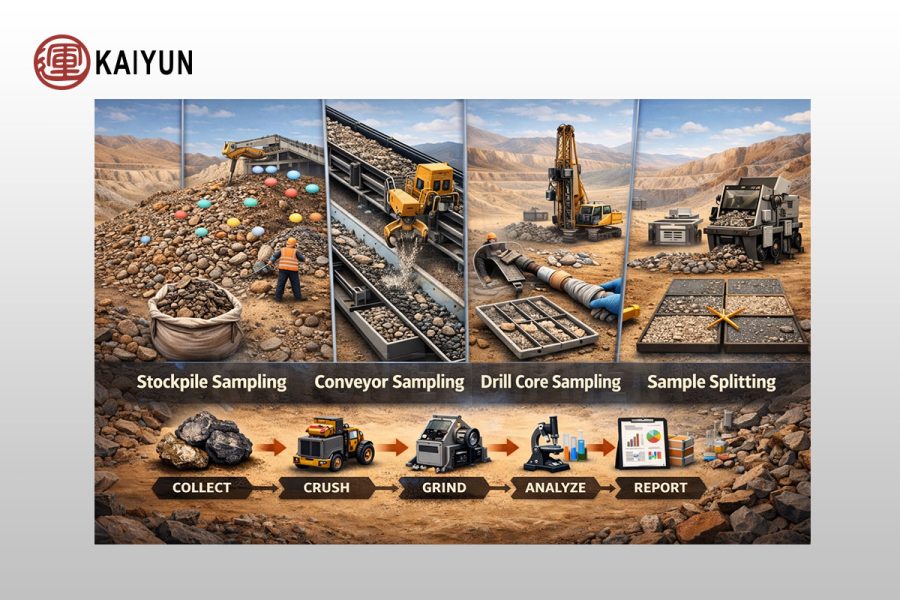
Why Ore Sampling Is So Important
Ore is naturally uneven.
Valuable minerals like gold and copper are not evenly distributed.
This means:
A poor sample does NOT represent the whole ore body
Assay results become unreliable
Process design becomes inaccurate
Final recovery rate drops significantly
Common Ore Sampling Methods
1. Stockpile Sampling (Most Common Method)
Application: Ore piles, raw ore storage
How it works:
Divide the stockpile into multiple zones (top, middle, bottom)
Take random samples from each zone
Mix all samples into one composite sample
👉 Key point: Multi-point + uniform mixing
2. Conveyor / Stream Sampling (Most Accurate Method)
Application: Operating plants, moving ore or slurry
How it works:
Take samples at regular intervals from conveyor belts or slurry streams
Ensure full cross-section sampling (not just surface material)
👉 Advantage: Highest representativeness (strongly recommended)
3. Drilling Sampling (Exploration Stage)
Application: Geological exploration
How it works:
Collect core samples using drilling equipment
Sample according to depth intervals
👉 Used to analyze ore grade variation in the deposit
4. Quartering Method (Sample Reduction)
Application: Reducing sample size
Steps:
Mix the sample thoroughly and spread evenly
Divide into four equal parts
Take two opposite parts
Repeat until reaching required size
👉 Minimizes human bias
Common Sampling Mistakes (Critical to Avoid)
❌ Taking only surface samples
❌ Too few sampling points
❌ Poor mixing of samples
❌ Random hand grabbing
❌ Ignoring fine particles (often high in gold content)
👉 These mistakes lead to seriously distorted assay results
Recommended Standard Sampling Procedure
1.Multi-point sampling (different locations)
2.Combine and mix samples
3.Crushing (if necessary)
4.Sample reduction (quartering)
5.Send to laboratory for testing
Professional Tips to Improve Accuracy
✔ Recommended sample weight: 20–50 kg (raw ore)
✔ Prevent layering in wet ore samples
✔ Use mechanical sampling equipment whenever possible
✔ Perform duplicate samples for verification
Not Sure If Your Sample Is Accurate?
If your ore sample is not reliable,
👉 your entire processing solution may already be off track.
Get Expert Support for Your Ore Testing & Processing
Send us your details:
Ore type
Particle size
Processing capacity
We can help you:
✔ Optimize your sampling method
✔ Provide laboratory testing solutions
✔ Design a complete mineral processing flow
📩 Contact us today for a professional solution