Improve Gold Dissolution Speed
The Key to Higher Recovery in CIP Processing
In the Gold CIP (Carbon in Pulp) process,
gold must first dissolve before it can be adsorbed by activated carbon.
👉 If gold dissolves slowly or incompletely,
even the best carbon adsorption system cannot deliver high recovery.
Why Gold Dissolution Speed Matters
Dissolution speed is the starting point of gold recovery.
It directly determines:
🔹 The maximum achievable gold recovery
🔹 The required leaching time
🔹 The consumption of cyanide and auxiliary reagents
High gold losses in tailings are often not caused by poor carbon adsorption,
but by insufficient gold dissolution during leaching.
What Slows Down Gold Dissolution?
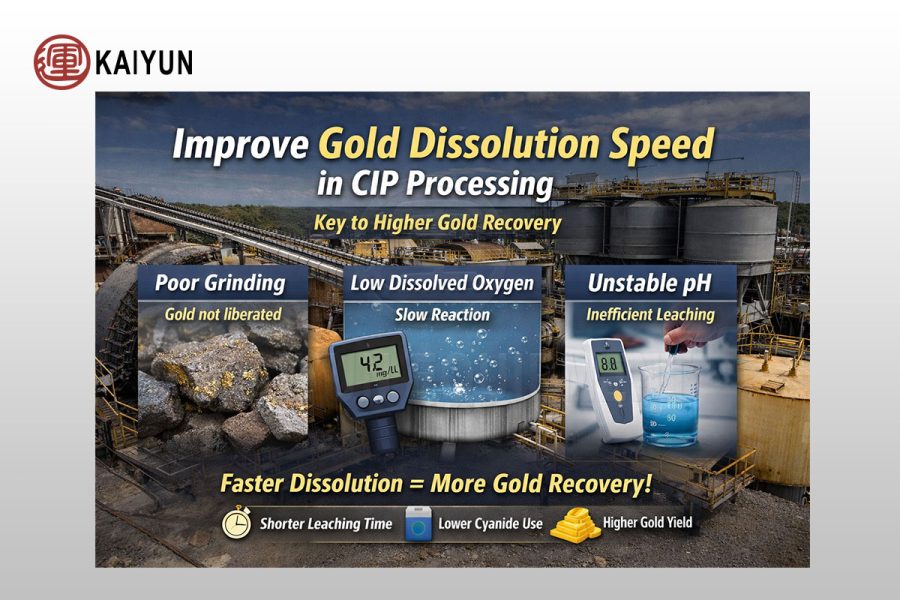
In practical CIP operations, common limiting factors include:
🔹 Insufficient grinding, gold not fully liberated
🔹 Low dissolved oxygen, slow reaction kinetics
🔹 Unstable pH, affecting cyanide efficiency
🔹 Surface passivation of gold particles
🔹 Interfering minerals consuming cyanide and oxygen
These issues usually lead to:
Longer leaching time · Higher reagent consumption · Lower recovery
Faster Dissolution Is Not About Using More Cyanide
Simply increasing cyanide dosage rarely solves the problem.
Effective improvement comes from optimizing the leaching environment:
Proper grinding to liberate gold particles
Stable pH control within a safe and effective range
Sufficient dissolved oxygen and good agitation
Appropriate leaching promoters to reduce surface passivation
This approach helps achieve:
✅ Faster leaching
✅ Lower reagent consumption
✅ More stable and higher gold recovery
The Core Logic of an Efficient CIP Plant
Liberate the gold · Dissolve it quickly · Adsorb it efficiently
In well-designed CIP systems,
leaching performance determines over 70% of the final plant results.Looking to Improve Your CIP Plant Performance?
We provide CIP process optimization support and complete equipment solutions
based on your ore characteristics and production targets.📩 Contact us for technical guidance and project solutions