In mineral processing projects, production capacity and ore quality indicators directly determine plant scale, equipment configuration, and overall profitability.
Among all technical parameters, raw ore processing capacity, daily ore processing capacity, and head grade of raw ore are the most critical indicators used in mineral processing plant design and operation.
Understanding these indicators helps mining companies reduce risks, control costs, and maximize mineral recovery.
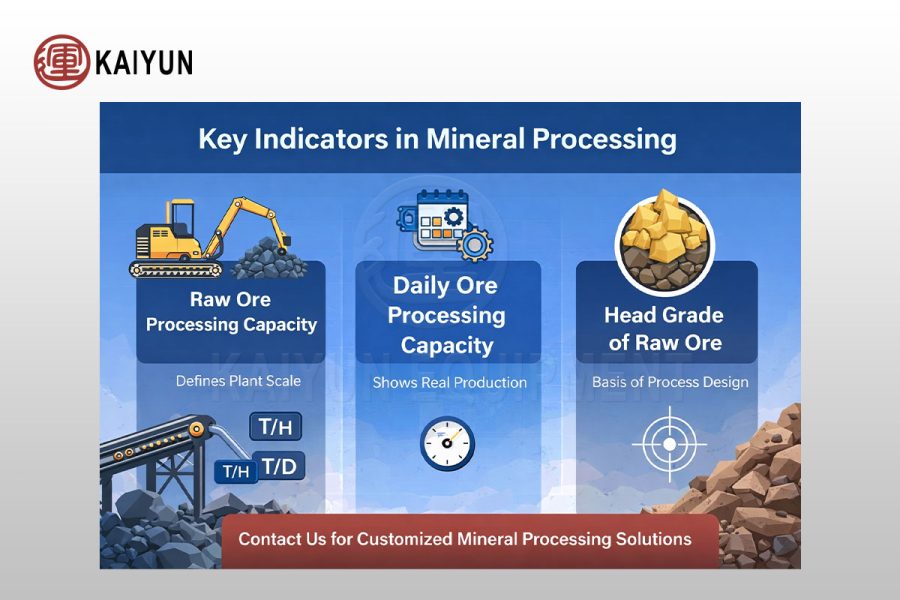
Raw Ore Processing Capacity
Defining the Scale of Your Mineral Processing Plant
Raw ore processing capacity refers to the volume of raw ore processed by a mineral processing plant or equipment per unit time.
It is the core indicator for determining plant capacity and production scale, forming the foundation for crushing, grinding, and separation system design.
Why Raw Ore Processing Capacity Matters
Determines equipment size and quantity
Affects power consumption and operating costs
Influences plant layout and material flow
Guides future capacity expansion planning
Raw ore processing capacity is typically expressed in tons per hour (t/h) or tons per day (t/d) and is a key input during feasibility studies and engineering design.
Daily Ore Processing Capacity
Measuring Real Production Performance
The daily ore processing capacity refers to the total volume of raw ore processed by a mineral processing plant within one day.
It is a daily accounting indicator derived from raw ore processing capacity and reflects actual operating conditions, including downtime, shift arrangements, and plant stability.
Applications of Daily Throughput Data
Evaluating daily production efficiency
Planning manpower and shift schedules
Estimating daily operating costs
Monitoring plant performance and bottlenecks
For mine owners and operators, daily ore processing capacity provides a clear and practical measure of real production output.
Head Grade of Raw Ore
The Basis of Mineral Processing Flowsheet Design
The head grade of raw ore refers to the content ratio of target valuable minerals contained in unprocessed raw ore.
It represents the original ore quality before beneficiation and is the fundamental basis for selecting mineral processing methods and equipment.
Why Head Grade Is Critical
Determines suitable separation methods
Affects expected recovery rates
Influences plant capacity and equipment scale
Impacts overall project economic feasibility
Accurate head grade data ensures efficient process design and stable mineral recovery performance.
How These Indicators Work Together
Raw ore processing capacity, daily ore processing capacity, and head grade of raw ore are interconnected parameters that define the efficiency and profitability of a mineral processing plant.
Together, they help engineers and investors:
Design reliable and scalable processing plants
Optimize equipment selection and process layout
Reduce operating risks and processing losses
Improve long-term return on investment
Customized Mineral Processing Solutions
Every ore body is different. Proper plant design requires a clear understanding of ore characteristics and capacity requirements.
We provide customized mineral processing solutions, including:
Capacity evaluation and plant design
Crushing, grinding and separation equipment
Flowsheet optimization based on ore tests
Technical support and engineering guidance
Contact Us for Professional Support
Whether you are planning a new mineral processing plant or upgrading an existing operation, our technical team can help you select the right capacity and process design.
👉 Contact us today to discuss your ore characteristics and processing requirements.