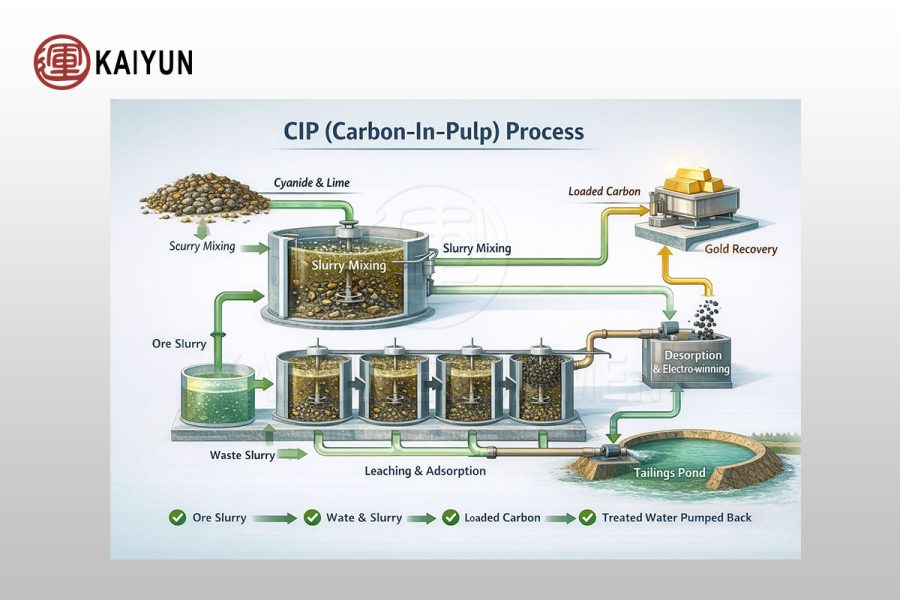
The CIP process is typically preferred based on ore type, gold occurrence, and economic considerations.
Applicable Ore Types
| Condition | Explanation |
| High gold content sulfide or oxide ores | Gold exists mainly as free gold or easily leachable gold; CIP gives high recovery efficiency |
| Fine or ultra-fine gold particles | CIP recovers fine gold more efficiently than gravity or flotation alone |
| Ores containing some clay or mud | CIP maintains good leaching efficiency even with complex ores |
| Low impurities (Ag, Cu, etc.) | Reduces reagent consumption and prevents lower recovery |
Gold Form and Distribution
Free gold dominant → CIP works very well
Partially locked gold (inside sulfides) → Pretreatment (roasting or oxidation) may be needed before CIP
Extremely fine gold → Difficult to recover with gravity separation; CIP is the best choice
Process and Economic Considerations
High recovery required → CIP can achieve over 95% recovery
Moderate to large processing capacity → CIP systems can operate continuously
Controlled reagent consumption → Cyanide and activated carbon use is manageable
Easy tailings management → CIP tailings are relatively clean and easy to handle
Summary: Typical Cases for Choosing CIP
Medium to high gold grade ore
Gold mainly in free or fine particles
Ore structure allows efficient leaching
High recovery rate is desired
Continuous operation and controlled reagent consumption are possible