Why Gold Is Lost in Tailings
Many gold processing plants focus on production capacity and recovery rates, but an important question is often ignored:
Where does the unrecovered gold go?
In many cases, it ends up in tailings.
Tailings are the waste materials left after mineral processing. Ideally, they should contain very little gold. However, in many operations, tailings still carry fine gold particles or dissolved gold, which means valuable metal is being lost.
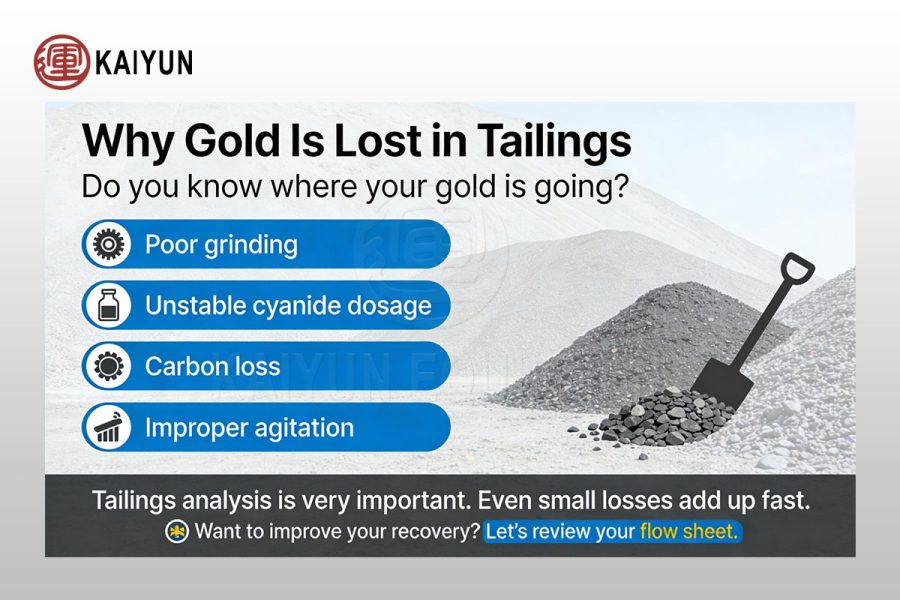
Common Reasons Gold Is Lost
Several operational issues can cause gold losses during processing:
1. Poor Grinding
If the ore is not ground fine enough, gold remains locked inside the rock and cannot be recovered during gravity separation or cyanide leaching.
2. Unstable Cyanide Dosage
Incorrect cyanide concentration can reduce gold dissolution efficiency, leaving part of the gold in the residue.
3. Carbon Loss
In CIP or CIL systems, activated carbon absorbs dissolved gold. If carbon escapes with slurry due to damaged screens or poor management, gold is lost directly into tailings.
4. Improper Agitation
Poor mixing reduces contact between cyanide solution and gold particles, leading to incomplete leaching.
Why Tailings Analysis Matters
Tailings analysis helps operators understand:
How much gold is being lost
Where the loss occurs
How to optimize the process
Even small losses can become significant over time. For example, a plant processing large volumes of ore every day may lose substantial gold if tailings are not monitored properly.
Regular tailings testing and process optimization can greatly improve gold recovery and overall profitability.