The Core Principle of Gold Adsorption in Cyanide Leaching
Activated carbon adsorption is one of the most important technologies in modern gold extraction. In cyanide leaching processes, activated carbon is used to recover dissolved gold from solution efficiently.
This technology is widely applied in gold processing plants through methods such as Carbon-in-Pulp (CIP) and Carbon-in-Leach (CIL).
Understanding why activated carbon can adsorb gold helps mining operators optimize recovery rates and improve plant efficiency.
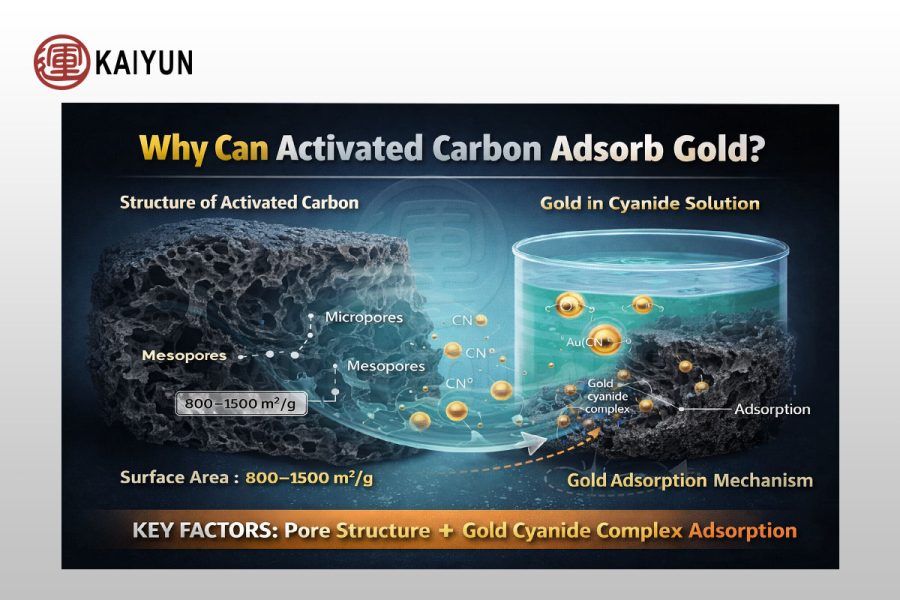
Structure of Activated Carbon
Activated carbon is a highly porous material with an extremely large internal surface area.
Its internal structure can be described as a three-dimensional network of microscopic pores, including:
Micropores,Mesopores,Macropores
These pores create a huge adsorption surface area, often reaching 800–1500 m² per gram.
In simple terms, a small piece of activated carbon behaves like a microscopic sponge, providing millions of tiny adsorption sites for dissolved metals.
This porous structure allows activated carbon to effectively capture and retain gold-bearing ions from the solution.
How Gold Exists in Cyanide Solution
During the gold leaching process, gold does not remain as a solid metal.
Instead, it dissolves in the cyanide solution and forms a stable complex ion known as the Dicyanoaurate Ion.
Chemical formula: Au(CN)₂⁻
This ion carries a negative electrical charge and remains dissolved in the leaching solution.
Recovering gold from this solution requires a material that can selectively attract and retain these gold-bearing ions.
Adsorption Mechanism of Activated Carbon
The adsorption of gold onto activated carbon involves a combination of physical adsorption and electrochemical interactions.
When the cyanide solution flows through activated carbon:
Gold cyanide ions move toward the carbon surface.
The ions enter the micropores within the carbon structure.
Active adsorption sites on the carbon attract and hold the gold ions.
As a result, gold becomes concentrated on the surface and inside the pores of the activated carbon particles.
This process allows gold to be separated efficiently from large volumes of solution.
Why Activated Carbon Is Ideal for Gold Recovery
Activated carbon has several properties that make it the preferred adsorbent in gold processing plants:
Highly developed pore structure
Provides a massive surface area for adsorption.
Strong affinity for gold cyanide complexes
Allows selective adsorption of gold from solution.
Mechanical strength and durability
Carbon can withstand multiple adsorption–desorption cycles.
Easy regeneration
Gold can be recovered through desorption and electrowinning processes.
Because of these advantages, activated carbon remains the most widely used adsorption material in the gold mining industry.
Applications in Gold Processing Plants
Activated carbon adsorption is commonly used in:
CIP gold processing plants
CIL gold processing plants
Carbon column adsorption systems
Heap leaching recovery circuits
These technologies enable mining companies to achieve high gold recovery rates with relatively low operating costs.
Key Factors Affecting Gold Adsorption Efficiency
Several operational factors influence adsorption performance:
Carbon particle size
Carbon activity level
Cyanide concentration
pH of the solution
Temperature
Presence of competing ions
Proper plant design and process control are essential to maintain high gold recovery.
Improve Your Gold Recovery with Professional Processing Solutions
A well-designed adsorption and desorption system can significantly increase gold recovery while reducing operational losses.
If you are planning a gold processing plant or upgrading an existing one, our engineering team can provide:
Gold beneficiation process design
Activated carbon adsorption systems
Desorption and electrowinning equipment
Complete gold processing plant solutions
📩 Contact us today to receive:
Free ore analysis
Customized gold processing flowchart
Professional equipment configuration