Why Is There a Difference in Recovery Between Coarse Gold and Fine Gold?
Centrifugal concentrators are widely used in gold gravity separation due to their high efficiency, compact design, and low operating cost.
However, many mine owners notice that the recovery rate for coarse gold and fine gold is not the same.
Understanding this difference is the first step to designing an efficient gold recovery process.
Below we explain how particle size, settling behavior, and equipment characteristics affect recovery performance.
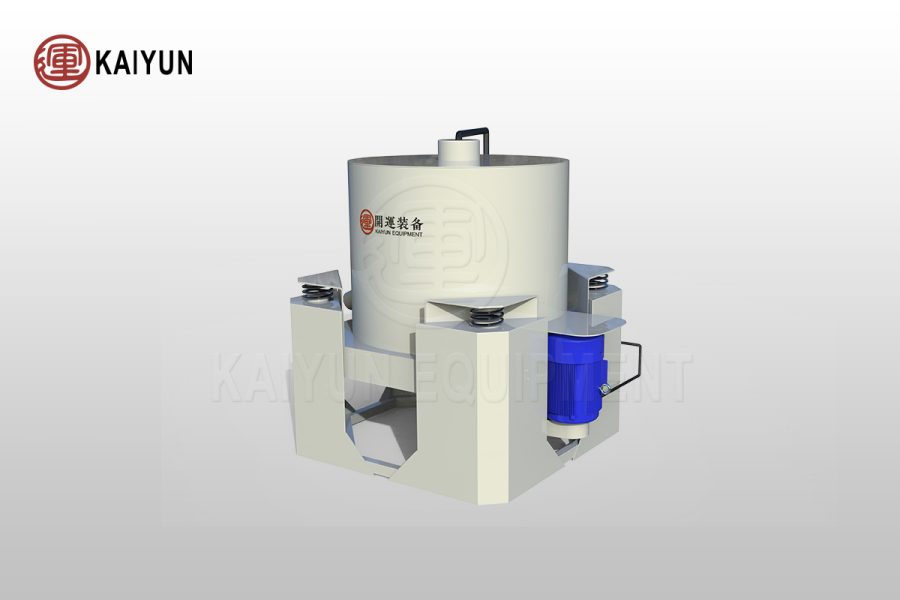
Coarse Gold: The Strongest Area of a Centrifugal Concentrator
Coarse gold generally refers to particles larger than 0.074 mm (200 mesh).
These particles have a large size and a clear density advantage, making them extremely easy for the concentrator to capture.
Advantages when processing coarse gold:
High settling speed, strong density contrast
Coarse particles move quickly under centrifugal force and are easily trapped in the riffles.
Stable behavior under water flow
Larger particles are less influenced by turbulence or flow velocity.
High-grade concentrate in a single pass
In most cases, recovery reaches 80–95%, depending on ore characteristics.
Conclusion: A centrifugal concentrator is one of the best solutions for coarse free gold recovery.
Fine Gold: Recoverable, but More Technically Challenging
Fine gold typically refers to particles smaller than 200 mesh, including ultrafine gold down to 300–600 mesh.
These extremely small particles are the primary source of gold losses in many mines.
Challenges when recovering fine gold:
Reduced settling velocity
Ultrafine particles are easily carried away by water flow.
Interference from slimes and clay
High slimes content reduces adhesion and capture efficiency.
Equipment limitations
Standard centrifugal concentrators work best up to ~200 mesh.
Beyond this level, recovery drops unless specialized models are used.
Conclusion: Centrifugal concentrators can recover fine gold, but recovery varies by particle size, ore composition, and machine type. Additional process stages are often required.
How to Improve Fine Gold Recovery? Recommended Process Combinations
To maximize fine gold recovery, most successful mines use multi-stage gravity flows rather than relying on a single machine.
1) Gravity Pre-Separation + Centrifugal Concentrator
Jigs or spiral chutes remove coarse heavy minerals
The concentrator focuses on fine gold only
Reduces overload and improves fine gold capture
2) Concentrator + Shaking Table Upgrade
The concentrator produces a fine gold-rich concentrate
A shaking table upgrades grade and minimizes losses
Ideal for small and mid-size gold plants
3) Ultrafine Gold Specialized Machines
For gold finer than 300–600 mesh, use enhanced models like:
Falcon UF (Ultra-Fine) Series
Knelson CVD
Enhanced gravity concentrators with high-G force
Proper combinations can boost fine-gold recovery by 15–35%.
Summary: Performance Comparison
| Category | Coarse Gold (>0.074 mm) | Fine Gold (<0.074 mm) |
| Recovery Difficulty | Low | High |
| Recovery Rate (Centrifuge) | High, stable | Variable, depends on particle size |
| Process Needs | Single stage usually enough | Multi-stage recommended |
| Investment Cost | Low | Medium to high |
Who Should Read This Article?
This news page is ideal for:
Gold mines with significant free gold content
Mines suffering losses of fine or ultrafine gold
Investors planning to purchase a centrifugal concentrator
Operations seeking a complete gravity recovery flowchart
If you need help selecting the proper model, estimating recovery rate, or designing a full gold recovery flow, we can analyze your ore sample and propose a suitable solution.
Contact Us|Get a Free Gold Recovery Process Evaluation
Henan Kaiyun Intelligent Equipment Co., Ltd.
Specializing in centrifugal concentrators, shaking tables, gravity separators, and turnkey gold processing solutions.
Send us your ore sample details, particle size, photos, or inquiry link — we will provide a free technical analysis and suggested equipment list.